

The Step-by-Step Process of Designing a Custom Engagement Ring
A custom engagement ring transforms a universal symbol of love into something deeply personal — a one-of-a-kind piece shaped by your story, your taste, and your partner's individuality. But how does the process actually unfold from the first spark of an idea to the finished ring on your finger?
This guide walks you through every phase of the custom engagement ring design journey, with practical advice drawn from decades of bespoke jewellery craftsmanship in Melbourne.
Step 1 — Establish Your Budget and Timeline
Before you begin sketching dream designs, ground yourself with two practical realities: how much you can spend, and when you need the ring.
Custom engagement rings vary enormously in price depending on materials, gemstone quality, and design complexity. Setting a realistic budget early lets your jeweller guide you toward the best possible outcome within your means. Many jewellers also offer payment plans that make higher-quality pieces more accessible.
As for timing, the full custom process — from initial consultation through to final delivery — typically takes between four and ten weeks. At Joseph George Jewellery, the journey from initial consultation to completed ring typically takes 6–8 weeks, which includes design development (1–2 weeks), stone selection (1 week), and handcrafting (4–6 weeks). Starting earlier is always wise for intricate designs or rare gemstones, and it removes the pressure that can lead to rushed decisions.
Step 2 — Gather Inspiration and Define Your Vision
You do not need to arrive at your first consultation with a finished blueprint. What helps enormously is a collection of images and ideas that signal your aesthetic direction.
- Save photos from Instagram, Pinterest, or jewellery websites that catch your eye
- Note which details attract you — is it the shape of the stone, the style of the band, or the way the light catches the setting?
- Pay attention to your partner's existing jewellery. Do they lean toward minimalist pieces, vintage styles, or bold contemporary designs?
- Consider lifestyle factors — an active person may prefer a low-profile bezel setting over a high cathedral mount
Bringing reference images, mood boards, or even rough sketches to your consultation gives your jeweller a powerful starting point for the collaborative design conversation ahead.
Step 3 — Choose the Right Jeweller
The relationship with your jeweller is arguably the single most important factor in the custom design experience. You want someone who listens intently, communicates transparently, and has the technical expertise to execute complex designs.
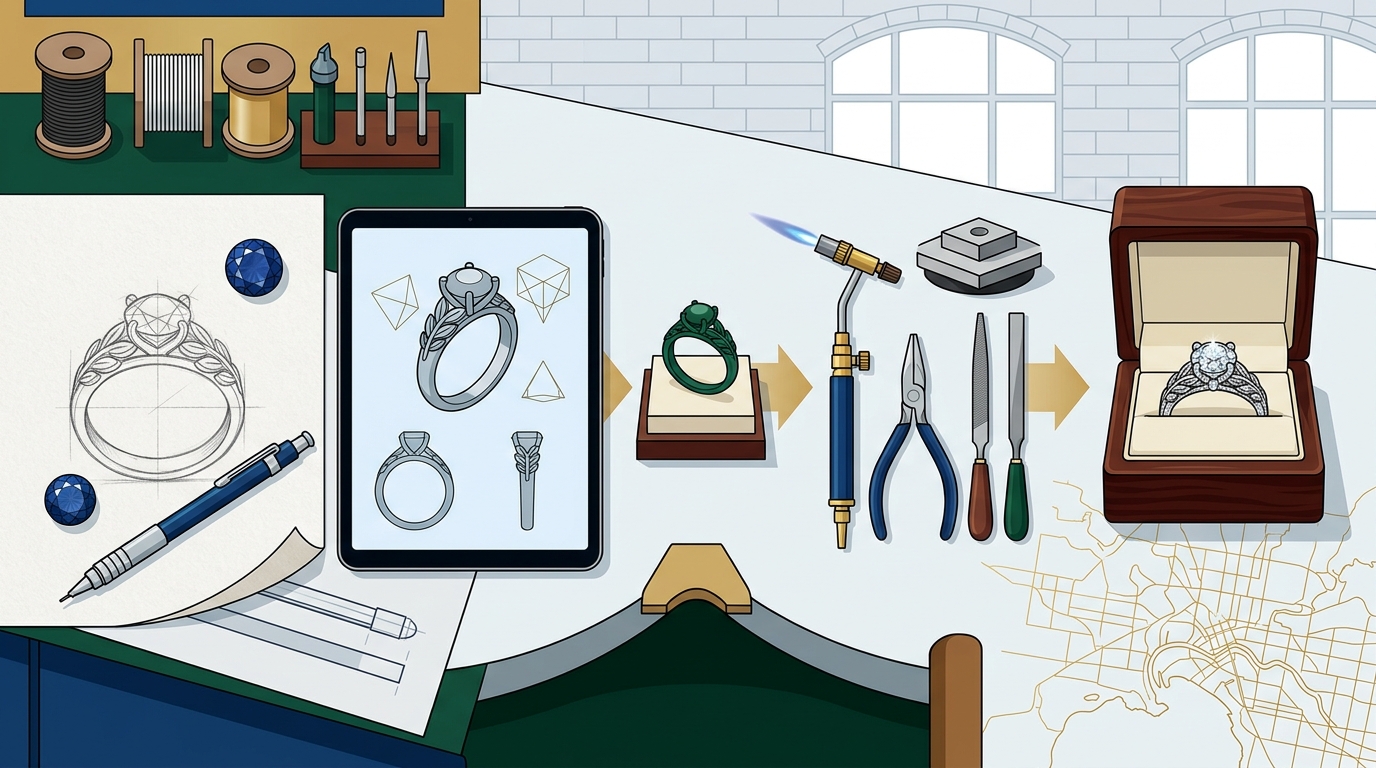
Look for a jeweller who provides a collaborative process, offering sketches, 3D renderings, or physical models so you feel confident about the final design at every stage. Review their portfolio of past custom work, read client testimonials, and — if possible — visit their studio in person.
Joseph George Jewellery, located at 271 Collins Street in the heart of Melbourne, is led by a second-generation jeweller with more than 40 years of experience. Joseph works intimately with every couple during the design process to share his extensive knowledge and ensure each handmade engagement ring looks like a dream brought to life. The studio's transparent pricing model avoids mall markups, and every client receives a detailed quote upfront with no hidden fees.
Step 4 — The Initial Design Consultation
This is where the magic begins. During a one-on-one consultation, you sit down with your jeweller to discuss ideas, likes and dislikes, stone preferences, and practical requirements such as ring size and comfort fit.
A skilled jeweller will ask thoughtful questions to understand not just what you want visually, but the story and emotions behind the ring. At Joseph George, this vision session is free and obligation-free — you can bring sketches, Pinterest boards, or gemstone preferences and refine them into a cohesive design direction.
By the end of this meeting, you should have a shared understanding of the ring's overall concept, including approximate stone size, metal choice, setting style, and any personal flourishes such as engravings or hidden details.
Step 5 — Select Your Gemstone
Your centre stone is the heart of the ring, and choosing the right one requires balancing beauty, durability, and budget.
Understanding the 4Cs of Diamonds
If you are choosing a diamond, understanding the four Cs will help you select the best stone within your budget:
- Carat — the weight of the diamond
- Cut — how well the facets interact with light, affecting brilliance and fire
- Colour — how colourless the diamond appears, with the most valuable being completely colourless
- Clarity — how free the stone is from inclusions and blemishes
Your jeweller will source a curated selection of certified stones for you to compare in person. Seeing diamonds side by side under proper lighting reveals differences that photographs simply cannot capture.
Beyond Diamonds
You can also choose coloured gemstones such as sapphires (known for rich blue hues and excellent durability), emeralds (lush green but softer), rubies, or aquamarines. Both natural and lab-grown diamonds are available — they are physically, chemically, and optically identical, differing only in origin.
Using an Heirloom Stone
Many couples choose to incorporate a family diamond or gemstone into a new custom setting. This preserves sentimental value while creating something fresh and modern. Most experienced jewellers can accommodate this, creating what is known as a custom semi-mount that includes everything except the centre stone.
Step 6 — Choose Your Metal and Setting Style
Metals
The metal you choose will influence both the aesthetic and the long-term wear of your ring:
- Platinum — rare, silvery-white, hypoallergenic, and extremely durable
- 18k White Gold — bright and lustrous, less expensive than platinum
- 18k Yellow Gold — timeless and classic, available in different weights and finishes
- 18k Rose Gold — warm pinkish hue, increasingly popular for contemporary designs
Setting Styles
The setting holds your gemstone and defines the ring's overall character:
- Solitaire — a single stone in a simple band, letting the gem speak for itself
- Halo — a centre stone encircled by smaller accent stones for added sparkle
- Three-Stone — a trio of gems symbolising past, present, and future
- Vintage-Inspired — intricate details like milgrain edging, filigree, and engraving
- Bezel — the stone is encased within a metal rim, ideal for active lifestyles
Band and Fit Details
Do not overlook the shank. You can choose from fully round, half-round, squared, or knife-edge profiles. Comfort-fit edges with a slightly domed interior make the ring more pleasant for all-day wear, which is especially important for wider bands.
Step 7 — CAD Rendering and Wax Model Approval
Modern custom jewellery benefits from Computer-Aided Design (CAD) technology that transforms your ideas into precise 3D models. These digital renderings let you view the ring from every angle — top, side, and profile — before any metal is shaped.
CAD images allow you to check proportions, evaluate how high the centre stone sits, and confirm that design elements like halos or pavé detailing look as impactful as intended. Most jewellers will refine the CAD through multiple iterations based on your feedback.
For complex or highly detailed designs, a physical wax model may also be produced. This life-sized prototype lets you hold the ring, try it against your hand, and request final adjustments to sizing, orientation, or stone weight before production begins. At Joseph George, modern 3D printing technology is used alongside traditional hand-finishing techniques to achieve precision and artistry in equal measure.
Step 8 — Handcrafting and Stone Setting
With your final approval on the design, the master jeweller begins transforming precious metals and gemstones into the finished ring. This stage is where decades of craftsmanship matter most.
The ring is cast or hand-fabricated from your chosen metal, then meticulously shaped, polished, and prepared for stone setting. Each gem is set by hand — whether in prongs, bezels, or pavé channels — and the finished piece is carefully examined to ensure every detail matches the approved design.
This manufacturing and stone-setting phase typically takes 4–6 weeks for standard designs, though highly complex pieces may require additional time. Throughout this period, reputable jewellers keep you updated with progress photos and milestone notifications.
Step 9 — Quality Inspection and Final Delivery
Before the ring reaches your hands, it undergoes a thorough quality check. The jeweller verifies that stones are secure, the ring fits correctly, the metal finish is flawless, and every specification has been met.
This final review is your opportunity to inspect the ring in person and request any minor adjustments. At Joseph George Jewellery, custom-made engagement rings come with a lifetime guarantee on materials and craftsmanship, along with complimentary cleaning and polishing services to keep your ring looking as brilliant as the day it was finished.
Key Takeaways
- Start 8–10 weeks early — this allows sufficient time for consultations, design revisions, stone selection, crafting, and adjustments
- Set your budget first — custom does not necessarily mean more expensive; costs are driven primarily by materials and complexity
- Bring visual references — mood boards, screenshots, and sketches accelerate the design conversation
- Trust your jeweller — choose one who communicates openly, shows you renderings and models, and invites your feedback at every stage
- Understand the 4Cs — cut, colour, clarity, and carat are the universal language for evaluating diamond quality
- Insist on seeing CAD renders or wax models — never approve a design you have not fully visualised
- Ask about guarantees — a reputable jeweller stands behind their work with lifetime warranties and aftercare services
Frequently Asked Questions
How long does it take to design a custom engagement ring?
The complete process typically takes 4–10 weeks, depending on complexity and materials. At Joseph George Jewellery, the standard timeline is 6–8 weeks, covering design development, stone selection, and handcrafting. For intricate designs or rare gemstones, starting earlier is recommended.
Is a custom engagement ring more expensive than a ready-made one?
Not necessarily. Custom rings are priced based on the materials — such as the centre stone, side stones, and metal — and the design complexity. In many cases, a custom ring can be equally cost-effective as a pre-designed piece while being entirely more meaningful and unique to you.
Can I use my own diamond or heirloom stone in a custom ring?
Yes. Many jewellers, including Joseph George, frequently redesign rings using family diamonds, heirlooms, or gems you already own. This creates what is called a custom semi-mount, which includes everything except the centre stone.
What if I have no idea what I want?
That is perfectly fine. A good jeweller will guide you through the process with questions, sample pieces, and reference images. At Joseph George, the obligation-free consultation is specifically designed to help clients who may have only a vague idea refine their vision into a concrete design.
Do I need to visit the studio in person?
While in-person visits allow you to see and feel stones and try on wax models, many aspects of the custom process can be handled remotely through digital consultations and CAD approvals. Joseph George Jewellery accommodates interstate clients who may not be able to visit the Melbourne CBD studio.
What metals are available for custom engagement rings?
The most common options are platinum, 18k white gold, 18k yellow gold, and 18k rose gold. Each has distinct characteristics in terms of appearance, durability, hypoallergenic properties, and price. Your jeweller can help you choose the best metal based on your partner's skin tone, lifestyle, and budget.
Will I see the ring before it is finished?
Yes. Reputable custom jewellers provide CAD renderings, hand sketches, or wax models at key stages so you can review and approve the design before final production begins. You should never feel locked into a design you have not fully visualised.